Drone weight, balance and performance for Part 107
Loading and performance is its own area of the remote pilot knowledge test. Here is what FAA material says about weight, center of gravity, load factor and density altitude, and where it is written for airplanes.
Practice with cited answers on your phone.
Get Part 107 TrainerKey facts
- A small unmanned aircraft must weigh less than 55 pounds on takeoff, including everything on board or otherwise attached.14 CFR 107.3
- The center of gravity is not a fixed point; it moves as loads are shifted or used up, and it must stay within the allowable limits.AC 107-2A, B.2.2
- High elevations, high air temperatures and high humidity (high density altitude) may require a weight reduction before flight.AC 107-2A, B.2.1.1
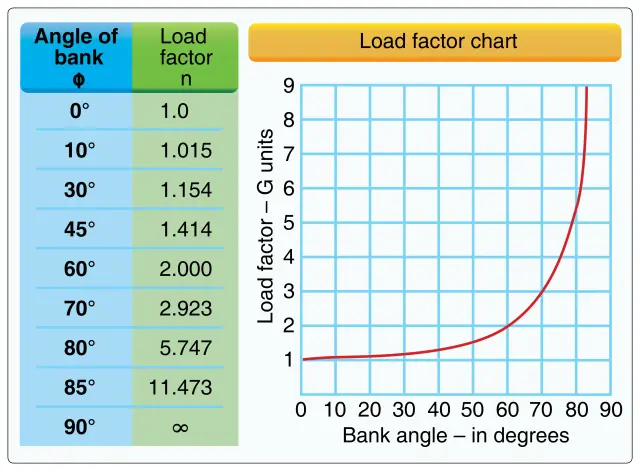
- In a coordinated level turn, the load factor is 2 Gs at 60 degrees of bank and 5.76 Gs at 80 degrees.FAA-G-8082-22, Chapter 4
- Stall speed increases in proportion to the square root of the load factor, so 4 Gs doubles it.FAA-H-8083-25C, Chapter 5
- Before flight, the remote pilot in command must ensure there is enough available power for the intended operational time.14 CFR 107.49(d)
Drone weight and balance starts with one legal number: a small unmanned aircraft weighs less than 55 pounds on takeoff, including everything on board or otherwise attached (14 CFR 107.3). After that, the FAA asks you to load within the manufacturer’s limits, understand how the center of gravity and turns change the loads on the aircraft, and know how hot, high and humid air cuts performance.
Loading and performance is one of the five areas of the remote pilot knowledge test. Since September 29, 2025 it has been 2 percent of the scored items, about 1 of 60, according to the blueprint in PSI’s UAG bulletin (PSI UAG Information Bulletin). That replaced the 7 to 11 percent range in the ACS, which the FAA’s August 2025 advisory calls obsolete (FAA ATCA, August 2025). Density altitude is listed under Weather (FAA-S-ACS-10B, UA.III.B.K1a). The area’s references include the Pilot’s Handbook of Aeronautical Knowledge (FAA-S-ACS-10B, UA.IV.A), and the study guide’s load factor text matches that handbook, so parts of it are written in airplane terms. This guide notes where.
The 55-pound limit and what counts
The definition says less than 55 pounds, so an aircraft at 55 pounds or more on takeoff is not a small unmanned aircraft under Part 107. Everything on board or attached counts. When you carry property, the total weight of the aircraft including that property must stay under 55 pounds (AC 107-2A, 5.15.1).
Two related rules apply to anything you carry. Before flight, you must ensure any object attached or carried is secure and does not adversely affect the flight characteristics or controllability of the aircraft (14 CFR 107.49(e)). And you may not allow an object to be dropped in a manner that creates an undue hazard to persons or property (14 CFR 107.23(b)).
Do not confuse 55 pounds with 0.55 pounds. The smaller number is the maximum weight for Category 1 operations over people (AC 107-2A, 8.2). The Part 107 rules guide covers the other operating limits.
Weight, balance and center of gravity
Before any flight, the remote pilot in command should verify the aircraft is correctly loaded and follow the weight and balance limits set by the manufacturer or builder (AC 107-2A, B.2.1). A listed maximum takeoff weight is not safe in all conditions. High elevations, high air temperatures, high humidity, the launch area’s length, surface and slope, surface wind and obstacles may all call for less weight (AC 107-2A, B.2.1.1).
The center of gravity (CG) is the point where the aircraft’s weight can be considered concentrated; supported exactly there, it would balance in any attitude. Its position has a great bearing on stability (FAA-G-8082-22, Chapter 4). The CG is not a fixed point. It depends on how weight is distributed, so it moves when you shift or use up a load. If the CG is outside the allowable limits after loading, or will not stay within them during flight, you relocate or shed weight before flying (AC 107-2A, B.2.2). Flying with the CG outside approved limits results in control difficulty (FAA-G-8082-22, Chapter 4).
Weight can also change in flight. Fuel burn is the most common change, and it can affect balance. In UAS operations, weight may also change when expendable items on board are used, such as a jettisonable load (AC 107-2A, B.2.1.2).
What overloading does
Lift is the only force that counteracts weight, and if weight is greater than the lift generated, the aircraft may be incapable of flight (FAA-G-8082-22, Chapter 4). Added weight also means a higher angle of attack, more drag and less reserve thrust for climbing (FAA-G-8082-22, Chapter 3b).
The study guide lists the main deficiencies of an overloaded aircraft: higher takeoff speed, longer takeoff run, reduced rate and angle of climb, lower maximum altitude, shorter range, reduced cruising speed, reduced maneuverability, higher stalling speed, higher approach and landing speed, and longer landing roll. The first sign of poor performance from improper loading usually comes during takeoff (FAA-G-8082-22, Chapter 4). The list uses airplane terms such as takeoff run and landing roll, and the guide gives no separate figures for multirotor aircraft.
Load factor in turns
Load factor is a proportion between lift and weight, measured in Gs. A load factor of 3 means the total load on the structure is three times the aircraft’s weight. It matters for two reasons: you can overload the structure, and a higher load factor raises the stall speed (FAA-G-8082-22, Chapter 4).
| Bank angle in a coordinated level turn | Load factor |
|---|---|
| 60 degrees | 2 Gs |
| Greater than 72 degrees | 3 Gs |
| 80 degrees | 5.76 Gs |
| Slightly more than 80 degrees | More than 6 Gs |
Sources: FAA-G-8082-22, Chapter 4; FAA-H-8083-25C, Chapter 5. Load factor rises at a terrific rate after about 45 or 50 degrees of bank, and a constant-altitude turn at 90 degrees is not mathematically possible.
Stall speed increases in proportion to the square root of the load factor. An aircraft that stalls at 50 knots unaccelerated can stall at 100 knots at 4 Gs. In a bank steeper than 72 degrees, an aircraft with a 45-knot stall speed must stay above 75 knots to avoid a stall (FAA-H-8083-25C, Chapter 5). The testing supplement includes a load factor chart as Figure 2 (FAA-CT-8080-2H).
The study guide applies this to any aircraft in a coordinated turn, but the stall passages describe airflow over an airfoil in airplane terms (FAA-G-8082-22, Chapter 4). It does not give separate load factor figures for multirotor aircraft.
Density altitude: high, hot and humid
Density altitude is the altitude in the standard atmosphere that corresponds to a particular air density. As density altitude rises, air is thinner and aircraft performance decreases. High elevations, low atmospheric pressure, high temperatures and high humidity produce high density altitude; low elevations, high pressure, low temperatures and low humidity produce low density altitude (FAA-G-8082-22, Chapter 3b).
The study guide explains each factor. Density is directly proportional to pressure at constant temperature and varies inversely with temperature at constant pressure. Water vapor is lighter than air, so moist air is less dense. Humidity alone is usually not considered an essential factor in calculating density altitude, but it contributes. Standard sea level conditions are 29.92 inches of mercury and 59 degrees Fahrenheit (15 degrees Celsius), and climb performance diminishes with altitude (FAA-G-8082-22, Chapter 3b).
The ACS lists density altitude under weather effects on performance (FAA-S-ACS-10B, UA.III.B.K1a), and the testing supplement includes a density altitude chart as Figure 8 (FAA-CT-8080-2H). The temperature and altimeter setting come from reports you can decode with the METAR and TAF guide.
Batteries, power and performance data
If your aircraft is powered, you must ensure before flight that there is enough available power for the intended operational time (14 CFR 107.49(d)). The FAA’s recommended preflight items include verifying an adequate power supply for the intended operation and checking battery levels for both the aircraft and the control station (AC 107-2A, 7.3.4).
Lithium-based batteries are highly flammable and capable of ignition, and a battery fire can cause loss of control. Short circuits, improper charging, extreme heat, crash damage, mishandling and defects can all start one, so follow the manufacturer’s handling recommendations when available (AC 107-2A, B.5).
For performance numbers, the manufacturer may provide data on takeoff, climb, range, endurance, descent and landing. That data is not standardized. If the manufacturer publishes none, the FAA suggests starting from data published by other users of the same model (AC 107-2A, B.1). The ACS lists the use of performance data as a knowledge area (FAA-S-ACS-10B, UA.IV.A.K2). For how this area fits the whole test, see the Part 107 study guide and the practice questions page.
Sources
Every fact on this page comes from these public FAA documents and the eCFR. If the FAA updates one, the source wins.
- 14 CFR 107.3, Definitions (eCFR)
- 14 CFR 107.23, Hazardous operation (eCFR)
- 14 CFR 107.49, Preflight familiarization, inspection, and actions for aircraft operation (eCFR)
- AC 107-2A, Small Unmanned Aircraft System (Small UAS), editorial update
- Remote Pilot Small UAS Study Guide, FAA-G-8082-22
- Pilot's Handbook of Aeronautical Knowledge, FAA-H-8083-25C
- Remote Pilot Small UAS Airman Certification Standards, FAA-S-ACS-10B
- Unmanned Aircraft General - Small (UAG) Information Bulletin (PSI PDF)
- FAA Airman Testing Community Advisory, August 2025 Edition
- Airman Knowledge Testing Supplement for Sport Pilot, Recreational Pilot, Remote Pilot, and Private Pilot, FAA-CT-8080-2H